Saturday, November 26, 2011

Golden Raisin Walnut Bread


This is truly a lovely bread. The combination of golden raisin and walnuts works very well together. The loaf has a small amount of whole-wheat flour (20%) that give the loaf just enough of a whole-wheat taste to keep it from being a "white" bread.

There was nothing unusual about this loaf. I followed the directions as given and had no surprises. The loaf was a bit wrinkled looking, something I've encountered with several of Hamelman's loaves, but this certainly didn't affect the taste. Overall, this recipe is topnotch and one of my favorites.

Sunday, October 30, 2011

Fougasse with Olives


Generally, the next months breads are posted a few days before the start of the month. That wasn't the case for November, so I went ahead and picked out one of the few remaining loaves and made it. My choice was the olive fougasse.

The home recipe makes two, so I divided the dough just before the addition of the olives and made one fougasse with olives and another without. I substituted a half-dozen chopped kalamata olives for the two tablespoons of niçoise olives. It was the only olive I had on hand and they worked well.

I would recommend care when rolling out the dough. In my case the I got the dough a little too thin giving an almost cracker texture. The bread was still quite good, but I would have preferred something a bit thicker and chewier. That said, this is another recipe for the winner's column.

Sunflower Seed Bread with Pâte Fermentée


The October breads were rounded out with a sunflower seed bread. I'm partial to sunflower seed breads and this was no disappointment.

The recipe includes rye chops which, early on in the challenge would have been off-putting. But now that I'm soaking the rye berries before tossing them into the food processor, this is no longer the problem it once was. I'm not sure they add a lot to the bread, but I like them now. And they aren't that much additional work.

This recipe produced a light, lovely loaf that I would gladly make a gain. A great loaf. And three winners in one month.

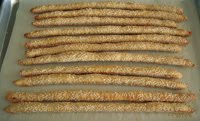
Sesame Bread Sticks


The sesame bread sticks recipe is another one-day recipe. Having previously made the grissini, I wasn't sure how these would be different. While a bit leaner, there really isn't much difference.

In making these, I was much more forceful when rolling out the dough not worrying whether I was deflating them too much or not. This proved to be the right tack to take as I was able to shape these better. I also cooked them longer going for a more crispy bread stick. In general, I prefer the chewy bread sticks, but after making these, I may have to rethink my position. These were very tasty and I really liked them crisp. But, as Hamelman warns, they only keep for around five days (if not eaten before then). A winner!

Berne Brot


The Berne brot is like challah but richer. The water in challah has been replaced with milk and the oil has been replaced with butter.

This is a straight dough that is easily made in one day. Hamelman's recipe for the home baker make three medium to smallish loaves. I made half the recipe and made one loaf and several buns. Otherwise, I followed the recipe as given.

In retrospect, I wish I had made the full recipe. This is a very tasty loaf. When comparing challah with this brot, I definitely prefer the latter.

Sunday, September 18, 2011

Whole Wheat with Pecans and Golden Raisins


There isn't a lot to say about this bread. As a straight dough, it only took one day to make this loaf. And, for a lack of a better word, it was a very straightforward loaf to make. I pretty much followed the recipe as written. (I did fudge and soak my raisins in rum rather than water.)

This produce a beautiful and tasty loaf. This is definitely a bread I would make again.

Sunday, September 4, 2011

Mixed-Flour Miche


This is quite an impressive loaf. The home recipe is for a single loaf with 3 pounds and 11 ounces of dough. (The professional loaf calls for 5 pounds of dough.) My home loaf, which spread perhaps more than it should, measured over 14 inches in diameter.

The loaf had an 83% hydration and was quite slack. As such, the dough was quite damp and difficult to work with. I used the three folds during the bulk fermentation and still didn't develop enough strength. The recipe calls for a final fermentation of two to two and a half hours (perhaps a bit too long, at least in my case). I used a linen-lined 12-inch skillet and inverted dough onto a large sheet of parchment prior to putting it into the oven. Even so, I had difficult getting the loaf into the oven. (If I were doing it again, I would use two overlapping sheets of parchment.)

Hamelman recommends cooling the loaf in a baker's linen and waiting at least 12 hours before cutting. (In the picture, I'm using the linen to hide the slightly misshaped edge.)

The loaf had a mildly sour taste and an open crumb. It had an excellent flavor and is a loaf that I hope to make again soon.