Monday, July 25, 2011

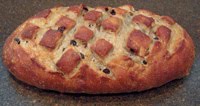
Sourdough Rye with Raisins and Walnuts


The third and final bread of the month was a 35% rye bread with raisins and walnuts. Between the relatively low rye content and the added raisins and walnuts, this did not come across as a rye bread. And since I don't particularly like rye breads, I consider this a strong point!

Whenever I cook breads with raisins (or olives if you just read the last post), I try to be careful to avoid exposed fruit that will char in the oven. Apart from this, the loaf is straightforward and easy to make. I used a hashed scoring that didn't really work well for this loaf in that it exposed some of the raisins and I didn't have as much oven spring as I would have liked. (Perhaps I should have allowed it to rise a bit longer?)

While a bit dense, this was still an excellent loaf and well worth making again.

Olive Levain


This is another terrific bread! I think the key to a good olive bread is good olives. If you wouldn't eat the olives out of the jar, why would you want to eat them in a piece of bread? For this recipe, I use Mezzetta Pitted Kalamata Olives that, according to the label, had been marinated with herbs in Napa Valley Cabernet. I really love these olives, and they worked well in this bread.

There were no problems with the recipe. The dough was a bit slack, but not enough to cause problems. As is my habit, I baked the bread in a cloche. A really great bread! I wish I had some left.

Potato Bread with Roasted Onions


What great bread! I love roasted root vegetables, and I particularly like roasted onions and potatoes. So I'm all for adding them to bread (and making a little extra to snack on)!

Since Hamelman notes that we can form the loaves several ways, I decided to make sandwich loaves. Although not on Hamelman's list of possibilities, these worked out nicely.

The bottom line, I really like this bread. A winner!

Tuesday, June 21, 2011

Vollkornbrot and Vollkornbrot with Flaxseeds


It's payback time. After two great breads, it couldn't last. Another rye. If you have been following this blog, you'll know I'm not enamored with rye breads and that hasn't changed.

Actually, I'd have to describe these two loaves a failures. While the blame may rest squarely on me, I simply didn't see enough in these two breads to make is work the effort to figure out what went wrong.

Rather than make two humongous loaves, I cut each recipe in half and baked the breads in the same pullman pan. The times and temperatures were the same, and there was very little difference between the loaves.

The dough was sticky and wet and difficult to work with. The results were heavy, stodgy; certainly not something that I would want to make again. Both loaves molded quickly and had to be discarded.

While I started out largely indifferent to rye breads, as this challenge go on, I'm liking them less and less. Two abysmal loaves!

Semolina Bread


This is one of four semolina breads in the book, the levain or sourdough version. It is somewhat unfortunate that we aren't making the others at the same time so we could compare them. However, some might have found that a bit overwhelming.

In general, I'm quite fond of semolina breads and this one didn't disappoint. I made the recipe twice. While the recipe specifies durham flour, the first time I used Bob's Red Mill Semolina Flour. The second time I used King Arthur's Durham Flour. According to Kastel's Artisan Breads the only real difference between the two flours is the grind; semolina has a coarser grind. While I could see a difference in the two flours, it wasn't that much of a difference. The second loaf is shown. I use the shaping technique described in The Bread Baker's Apprentice

Overall, this is a terrific loaf. I can't justify a preference between the two loaves, but slightly preferred the latter. A great loaf.

Pain Rustique


There really isn't a lot to say about this bread. It is very straightforward to make. Apart from a simple poolish that must be made the day before, it is relatively quick to make. It has a somewhat high hydration and is very similar to a ciabatta in many ways. The results are a light, airy rustic bread that is simply spectacular. It is an instant favorite!

Monday, May 23, 2011

Pissaladière


Rounding out the recipes for may is a pissaladieère, a French pizza. This is something I made before and am quite fond of. The crust is quite thin, so it has both an initial crispiness, but is also chewy around the edges or cornicione.

Hamelman's recipe works quite well. He doesn't give cooking times, perhaps because he recommends setting ovens as high as they will go and that introduces too much variability. I cooked mine at 550 degrees for about 8 minutes. But I didn't stretch my dough out as much as he recommended. Rather than 12 x 16 my pies were closer to 10 x 15.

Anchovies I can take or leave, but I generally prefer to leave them.
So for this recipe, I diced my anchovies rather than leaving them whole (and left them off part of the pie altogether). Dicing is in the spirit of things but keeps you from getting too much of an anchovy at once.

Finally, I found that the recipe really only made enough caramelized onions for one pie, not two. I would definitely make more next time.

Traditionally, this is made with caramelized onions, olives, and anchovies, just as Hamelman's recipe calls for. However, like pizza, it can be made with other toppings. For my second pie, I used a recipe for a tomato topping from Anissa Helou's Savory Baking from the Mediterranean. Another good choice would be caramelized onions, blue cheese and walnuts.

Bottom line, this is a great crust recipe and well worth going back to.