Tuesday, May 15, 2012

Decorative Platter

It has been quite a while since I posted anything to this blog, but I'm still not finished with Hamelman. The Mellow Bakers Challenge has come to an end and has been reborn. But I'm following my own course rather than baking with them.

The challenge stopped short of chapter 10 so I decided to go it alone. My first project met with mixed success. I began with the decorative platter (color plate #24). For this, it was necessary to scale back the recipe since it was designed for an oven that holds a full sheet pan, something my home oven doesn't do. Overall, the project went well as can be seen from the picture. There were two rather obvious initial problems with the platter. First, along the lower left border, the braid is way too loose. While easily corrected before baking, unfortunately I didn't notice this until after the platter came out of the oven. The second problem is the large gap between the two ends of the border at the top of the picture. This braid shrunk as the platter baked. This was something I hoped to cover with some of the decorations later in the chapter (a flower or two "glued" into place over the gap using Hamelman recipe for cooked sugar glue), but a third problem developed.

As can be seen in the second image, several large cracks developed in the platter. Once the platter developed the cracks, there was no point in going back and trying to deal with the gap. I put out an appeal on the Bread Baker's Guild of America's mailing list to see if anyone had any suggestions as to what might have caused the problem. Jeffrey Hamelman was kind enough to reply suggesting that it may have been over baked. This seems quite likely.

Despite the problems I encountered, I thought the platter looked spectacular and will definitely try again. I'm hoping to gain access to a kitchen with a larger oven this summer so I can attempt a full size platter and the cornucopia. I also plan to make a plaque or two attempting some of the decorative details described in chapter 10. I'll follow up with postings as I attempt this project.

As to other future postings, I certainly want to go back and retry some of the recipes in the book. As readers will note, rye bread have been a problem for me. Accordingly, I have enrolled in a two day course next fall taught by Hamelman on rye breads. I'll be retrying some of his recipes this summer in preparation for that course so expect future postings on my experiments and the course next fall.

Sunday, January 22, 2012

Semolina (Durham) Bread with a Whole-Grain Soaker


This recipe marks the "official" end to the Hamelman Challenge. With this loaf, all but the decorative projects have been done. That's ignoring variations on several recipes as well. At this point, I don't plan to go back through looking for variations, I do plan to continue and do at least two of the decorative projects. And once I've done that, I hope to do at least one more post about the project in general. But the end is upon us.

The last loaf was a fine recipe to end on. I'm fond of Semolina Bread to begin with and like whole-grain breads in this style. And this loaf was no disappointment. I used a durum flour (finer grind) than the semolina used on the last loaf but with the added whole grains, I can't say I saw much difference. Overall, this is a solid loaf. While not one of the very best, it was one of the best. A keeper!

Sunday, January 8, 2012

Semolina (Durham) Bread


This loaf is an oddity for Hamelman; it is a loaf that can be finished in one day. A "flying sponge" is created using all the yeast and is allowed to rest for an hour or so. The dough is created from this. From that point on, there is nothing unusual about making the loaf.

I'm particularly fond of semolina breads and this was no disappointment. The crumb was fine, golden, and very soft. The bread is delicious.

Monday, January 2, 2012

Roasted Garlic Levain


As we near the end of the challenge, this was another lovely loaf. It was very straightforward to make—and was very similar to many of Hamelman's other breads.

The bread has a very strong garlic aroma and a slightly bitter tasting crust. The crumb was very open. This was wonderful with fig preserves.

Un-kneaded Six-Fold French Bread


Well, even Hamelman has an un-kneaded or no-knead bread. Although with six folds, it almost seemed like I was kneading the dough. And it is worth noting that Hamelman's book came out two years before the no-knead revolution started by Jim Lahey and Mark Bittman. Still, no-knead breads have been around in one form or another for decades. There is a no-knead roll that was in the original 1931 edition of Joy of Cooking. This is not meant to diminish the work of Lahey and Bittman in refining and popularizing the technique. Indeed, there are numerous differences between Hamelman bread (notably the six folds) and Lahey's. And Lahey has a book loaded with variations.

There was nothing particularly difficult with this recipe apart from being tied to the kitchen in order to make the folds every thirty minutes. The dough produced was quite slack. I handled this quite gingerly when forming the loaves. And following Hamelman's suggestion, I used some of the dough to make pizza.

This produced a lovely rustic, ciabatta-like loaf with a very open crumb. This is a nice loaf for a paninis. And, as promised, the pizzas had a good, chewy crust. This is a recipe worth keeping.

66 Percent Rye Bread


This is the last of the 18 rye breads in Hamelman. And while I might be sadden that the challenge is nearing its end, finishing the rye breads came none to soon for me. This loaf was not, I regret, a spectacular success. Like too many of the rye loaves, it was a sad, heavy loaf with a coarse crust and a slightly dense crumb. Frankly, I must admit that I don't feel that I've truly mastered rye bread. My low percentage loaves have been fine, but the dense, high rye content breads simply don't appeal to me. When rye content goes above 50%, my interest in the loaf wanes.

This particular loaf fell neatly into this pattern of slightly dense crumb and coarse crust. There were no real problems or surprises with the loaf in that it behaved as many of the other loaves did. It was difficult to get it to pull together having a tendency to pool in the bottom of the mixer. When baked, it tended to break around rather than expand along the scoring. (I did try one experiment with this loaf that didn't really work. I used a template to add flour for a pattern and then tried to score across the pattern in a decorative way. This seems an interesting technique but it didn't work with this loaf. But it is something I'll try again with another bread.)

Not a bad bread, but not one I'll be in a hurry to repeat.

Challah Shaping Revisited


A couple of weeks ago, my wife and I attended a baking class taught by Peter Reinhart as part of Johnson and Wales Chef's Choice series, a series of Saturday morning recreational cooking classes. As part of that course, not only did we bake challah, but we brought home challahdough. Faced with a double portion of baked bread and unbaked dough, I used the unbaked dough to revisit the shaping lessons in Hamelman.

For the first braid, I improvised around the star loaf given in Hamelman. I made two changes. First, I used four and a half strands for each leg rather than six. That is, I cut three strands in half and created each leg with the half strand and two strands each from adjacent legs. Second, I used larger strands.

One suggestion I'd make for this loaf is to use small pieces of parchment for each of the formed legs. This makes it much easier to position the legs when combining the first three legs to make the intermediate legs.

For the most part, this loaf worked nicely. It was quite large—it came within an inch of the walls of my oven on either side, and I had to use two overlapping cookie sheets to bake it. Still, I think I had a better loaf this time than last. If I were doing it again, I would pay closer attention to the braid pattern at the top of the leg even if this is somewhat obscured by the rosette added in the middle of the loaf.

For the second loaf, I followed Hamelman closely. The major difference this time was that I extended the inner loops beyond the outer ring more in forming the loaf, joined them tightly, and then used a bench knife to get a good, clean edge. In retrospect, I should have used a bit more water joining them because I did get some separation at one point (upper left). Still, this is much better than last time.

These were fun loaves to revisit and much less formidable the second time around.

Tuesday, December 20, 2011

Sourdough Seed Bread


This is another seeded bread, another sourdough bread. As such, it doesn't seem all that different than some of the other breads we made in this challenge. Yet this recipe produced a spectacular loaf. This may have been due, in part, to my overcooking it a bit. At least, I cooked it until it was somewhat darker than I usually cook bread. And this loaf was clearly much better for it. In the future, I'll be looking to cook my loaves to a darker color. A great loaf, a loaf worth repeating!

Saturday, November 26, 2011

Five-Grain Levain


Once again, I find myself jumping ahead of the challenge. Last time around, I made the fougasse with olives. As it happened, I was only ahead for a couple of days. That was the first on the list of the next set of recipes. With only a few recipes remaining, that may well happen again.

This loaf was extremely similar to the last loaf I baked, the Five-Grain Sourdough with Rye Sourdough. This time around, I used rye flakes rather than cracked rye. Otherwise, the I followed the recipe as given.

This produced another lovely loaf, quite similar to the last. I may have a slight preference for the earlier loaf, but would be happy with either. Another great loaf.

Five-Grain Sourdough with Rye Sourdough


The title refers to this as having a rye sourdough. Actually, this starter is prepared from a standard sourdough culture, not a rye culture. And, as a possible alternative mentioned by Hamelman, I used rye chops rather than the cracked rye called for by the recipe. Apart for that, I prepared the loaf as described in the book.

The results were excellent. This produced a lovely loaf that is now one of my favorites.

Golden Raisin Walnut Bread


This is truly a lovely bread. The combination of golden raisin and walnuts works very well together. The loaf has a small amount of whole-wheat flour (20%) that give the loaf just enough of a whole-wheat taste to keep it from being a "white" bread.

There was nothing unusual about this loaf. I followed the directions as given and had no surprises. The loaf was a bit wrinkled looking, something I've encountered with several of Hamelman's loaves, but this certainly didn't affect the taste. Overall, this recipe is topnotch and one of my favorites.

Sunday, October 30, 2011

Fougasse with Olives


Generally, the next months breads are posted a few days before the start of the month. That wasn't the case for November, so I went ahead and picked out one of the few remaining loaves and made it. My choice was the olive fougasse.

The home recipe makes two, so I divided the dough just before the addition of the olives and made one fougasse with olives and another without. I substituted a half-dozen chopped kalamata olives for the two tablespoons of niçoise olives. It was the only olive I had on hand and they worked well.

I would recommend care when rolling out the dough. In my case the I got the dough a little too thin giving an almost cracker texture. The bread was still quite good, but I would have preferred something a bit thicker and chewier. That said, this is another recipe for the winner's column.

Sunflower Seed Bread with Pâte Fermentée


The October breads were rounded out with a sunflower seed bread. I'm partial to sunflower seed breads and this was no disappointment.

The recipe includes rye chops which, early on in the challenge would have been off-putting. But now that I'm soaking the rye berries before tossing them into the food processor, this is no longer the problem it once was. I'm not sure they add a lot to the bread, but I like them now. And they aren't that much additional work.

This recipe produced a light, lovely loaf that I would gladly make a gain. A great loaf. And three winners in one month.

Sesame Bread Sticks


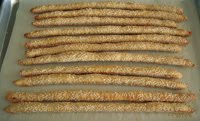
The sesame bread sticks recipe is another one-day recipe. Having previously made the grissini, I wasn't sure how these would be different. While a bit leaner, there really isn't much difference.

In making these, I was much more forceful when rolling out the dough not worrying whether I was deflating them too much or not. This proved to be the right tack to take as I was able to shape these better. I also cooked them longer going for a more crispy bread stick. In general, I prefer the chewy bread sticks, but after making these, I may have to rethink my position. These were very tasty and I really liked them crisp. But, as Hamelman warns, they only keep for around five days (if not eaten before then). A winner!

Berne Brot


The Berne brot is like challah but richer. The water in challah has been replaced with milk and the oil has been replaced with butter.

This is a straight dough that is easily made in one day. Hamelman's recipe for the home baker make three medium to smallish loaves. I made half the recipe and made one loaf and several buns. Otherwise, I followed the recipe as given.

In retrospect, I wish I had made the full recipe. This is a very tasty loaf. When comparing challah with this brot, I definitely prefer the latter.

Sunday, September 18, 2011

Whole Wheat with Pecans and Golden Raisins


There isn't a lot to say about this bread. As a straight dough, it only took one day to make this loaf. And, for a lack of a better word, it was a very straightforward loaf to make. I pretty much followed the recipe as written. (I did fudge and soak my raisins in rum rather than water.)

This produce a beautiful and tasty loaf. This is definitely a bread I would make again.

Sunday, September 4, 2011

Mixed-Flour Miche


This is quite an impressive loaf. The home recipe is for a single loaf with 3 pounds and 11 ounces of dough. (The professional loaf calls for 5 pounds of dough.) My home loaf, which spread perhaps more than it should, measured over 14 inches in diameter.

The loaf had an 83% hydration and was quite slack. As such, the dough was quite damp and difficult to work with. I used the three folds during the bulk fermentation and still didn't develop enough strength. The recipe calls for a final fermentation of two to two and a half hours (perhaps a bit too long, at least in my case). I used a linen-lined 12-inch skillet and inverted dough onto a large sheet of parchment prior to putting it into the oven. Even so, I had difficult getting the loaf into the oven. (If I were doing it again, I would use two overlapping sheets of parchment.)

Hamelman recommends cooling the loaf in a baker's linen and waiting at least 12 hours before cutting. (In the picture, I'm using the linen to hide the slightly misshaped edge.)

The loaf had a mildly sour taste and an open crumb. It had an excellent flavor and is a loaf that I hope to make again soon.


Sunday, August 28, 2011

Whole-Rye and Whole-Wheat Bread


This loaf is 50% high-gluten flour, 25% rye, and 25% whole-wheat. As such, the rye flavor is very weak and the dough is very easy to work with. This is my kind of rye bread, a loaf without much rye.

I use a newly acquire brotform to for the final proofing. In this case, I didn't get a particularly round loaf, and, clearly I'm still working out how much flour to use when dusting the form and what are the best approaches to scoring. Still, this gave a reasonably attractive loaf.

Overall, this was a pleasant loaf—one well worth making again.


Thursday, August 25, 2011

Black Bread


The final bread of the month was black bread. This is a sour dough rye that includes old bread and ground coffee.

Readers of this blog will recall that I'm not a fan of rye bread. This was a 60% rye, so I probably don't need to say anything else. But, just in case, the ground coffee did not improve the bread. While this bread might appeal to some, this was not my favorite bread. Enough said.

Focaccia and Focaccia con Formaggio


The 66th and 67th breads in this challenge are also loaves that I'll pair and discuss together. The 66th bread is focaccia and the 67th is focaccia with formaggio (focaccia with cheese). Both use Hamelman's ciabatta dough as a starting point.

With the former, the dough is divided into one pound pieces and placed in round pans, is covered with toppings, and is baked. In my case, I topped one with caramelized onions, blue cheese, and walnuts, one of my favorite combinations for focaccia. The other I topped with olive oil and chopped fresh rosemary. Any number of other toppings could be used. Hamelman provides a short list of other possibilities.

The focaccia with cheese is a bit different. It uses one and a half pounds of dough divided into two pieces. The pieces are rolled out. One is covered with ricotta cheese, salt, pepper, and fennel seeds. (I omitted the fennel seeds.) The second piece of dough in placed on top and crimped to the lower piece. Brush with oil, sprinkle on salt, add a few slits, and bake.

As you can see from the photos, I had a hard time waiting. I just barely got the photos. Both were excellent.