Friday, December 31, 2010

Brioche


This is a bread I've made many times before and never tire of. Eating a slice of brioche is almost like eating a slice of cake. Indeed, the famous words of Marie Antoinette "Let them eat cake" are said to be a mistranslation of "Let them eat brioche."

There are numerous good recipes for brioche. Peter Reinhart's Bread Baker's Apprentice has three of varying richness, Rich Man's Brioche, Middle-class Brioche, and Poor Man's Brioche. All are excellent. Shirley Corriher's CookWise contains two Ultimate Brioche recipes, one for bread-like brioche and one for cake-like brioche. And if you are looking for things to do with brioche, there are a number of variation to be found in Baking with Julia. So it should come as no surprise that I was eager to try Hamelman's recipe.

Brioche is a wonderfully versatile dough. When I did the Bread Baker's Apprentice Challenge, I used brioche to make pigs-in-a-blanket and Julia Child's variation on Beef Wellington among other things. I have the pans and have made the traditional brioche loaves or tĂȘtes before, but I find that shape isn't particularly useful. So this time around I began with a pullman's loaf shown above. The dough was placed in the pan in pieces, hence the segmentation you see. When done this way (an experiment), the loaf pulls apart easily as pieces, but can be sliced as well. This made great sandwiches, but I also ate a lot of it out of hand. I also used it to make cinnamon toast, eggs-in-a-basket, and bread pudding. French toast is also an obvious possibility. The dough handled pretty much as Hamelman said it would (although I didn't have his religious experience). It is a long but straightforward process.

The recipe makes quite a lot and seemed to be near the limit of what I would want to put in my mixer and more than I really need at one time. The second time around, I cut the recipe back by a third. This still made a lot of brioche to play with, about 36 ounces. I went to Baking with Julia for ideas and ended up using three recipes contributed by Nancy Silverton. I used 8 ounces to make the Savory Brioche Pockets. I took 1 ounce balls of dough and rolled them out into circles, added the filling, put another circle on top, crimped the dough, brushed with an egg glaze, and baked. The filling can be pretty much what ever you want making this a great general purpose recipe. (Silverton's recipe calls for potatoes, goat cheese, and asparagus which is what I used, but there is no reason to stick to this.)
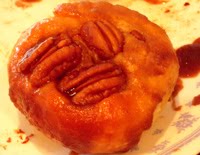
I used 18 ounces to make a pan of Pecan Sticky Buns. I skipped the lamination step (using brioche and additional butter to make a simple laminated dough) but the results were plenty rich without the added butter. (The original recipe, which is quite involved, is extraordinary, the best sticky buns I've ever had or am likely to ever have.) The remaining dough went to make a few Twice-Baked Brioches, little brioche rolls with an almond cream topping. That's quite a lot of product considering I was only using 2/3 of the original recipe.

Overall, Hamelman recipe is great, but then there are numerous other excellent recipes for brioche. How can you really go wrong with a dough that is so very rich? And so versatile?

Another favorite!

Horst Bandel's Black Pumpernickel


This is an extremely interesting loaf to make, but one that I'm not likely to repeat. It was certainly the most complex bread I've made thus far, a bread with a preferment and two soakers. I made this loaf a single time, which for me, is quite enough. While I can appreciate this bread, overall it really isn't to my tastes.

The ingredient list was problematic as it calls for rye meal, rye berries, and rye chops among other things. I used King Arthur's pumpernickel flour as the rye meal. My rye berries came from Whole Foods. The rye chops I made by putting rye berries in a food processor. This took a while and gave both the chopped pieces and rye flour. As has become my habit, I mixed the high gluten flour by adding vital wheat gluten to KA's bread flour. Also, I used regular molasses rather than black strap molasses.

When I began mixing the dough, it seemed too dry so I added 4 ounces of water. As it turned out, I was too hasty. Over the course of mixing the bread, I needed to add in an additional 10 ounces of flour to get the right consistency. Keep in mind, the recipe makes a 4 pound pullman's loaf, so the additions, while not desirable, were not a drastic as they might seem.

Following the recipe, the loaf was baked, left in the oven over night, and went through another day of resting before it was cut. The loaf pulled in slightly from the pan, so was easy to remove although quite a bit of moisture accumulate in the pullman pan.

The loaf was quite dark, darker than any loaf I've made, but I wouldn't describe it as almost black as did Hamelman. The loaf was also quite dense. This is a loaf to be sliced thin and served with a strong cheese or sausage, something that can stand up against the bread.

Overall, I learned a lot in the process, and I'm glad I made the bread. I can certainly appreciate the quality of the bread. But, overall, this isn't the kind of bread I crave. I'm afraid, that despite the effort, most of the loaf went uneaten.

Country Bread


Editorial Note: It has been a while since I've posted anything. I've still been baking, taking notes and pictures, and occasionally writing my blog comments out by hand for later postings. However, this isn't the same as writing the posts while they are fresh in my memory. For this I apologize.

The country bread recipe is a very nice, straightforward bread that is easy to make. It would be an ideal starting point for a beginner. There are no surprises here. Just follow the recipe. I maded this a couple of times. On both occasions, I shaped the loaves as fendu or split loaves. (You can see this better in the second picture.) I find this very easy to do, and the finished loaf is a useful shape. Moreover, I don't have to mess with slashing the loaves.

This was quite similar to the rustic bread, the next recipe in the book and a loaf that was baked earlier in the challenge. Frankly, I slightly prefer the rustic bread as it has a slightly more complex flavor due to the addition of a small amount of whole-wheat flour and whole-rye flour. There is enough of each to add flavor but not dominate the overall taste of the bread.

For the second preparation, I added 20% fresh asiago cheese to the bread as per the cheese bread recipe. This is shown in the second picture. You can see a bit of leakage at the bottom of the loaf.

All said and done, this may not be may absolute favorite, this is a good, solid recipe that is well worth repeating.

Sunday, October 24, 2010

Challah Revisited


Please note, the corrected amount of yeast for this recipe for the home cook is 9 grams of dry instant yeast. I have revisited this recipe using the Hungarian Ring as shown. This proved to be considerably more difficult than the star. With any braid, including the star, the strands tend to rise against each other giving a more even loaf. With the Hungarian braid, the individual strands stand out. If they are ill-formed, they remain ill-formed throughout the rise and baking process.

Rolling out the 4-foot outer ring was also a task. I repeated had to stop and allow it to rest. I had used an overnight retard. Hamelman suggest that this makes rolling the bread easier. I hate to think what it would have been like without that rest.

Also, as you can see, I had some difficulty sealing the interior pieces to the outer ring. During the cooking process, they tended to release, stand-up, and then overbrown.

Yeast Calculation

In calculating the yeast quantities in previous postings, I overlooked the switch from fresh yeast to instant dried yeast when going from production batches to home batches. As Hamelman notes on page 57, 1/3 as much instant yeast is needed. Thanks to Paul Yumarama for pointing this out!

Sunday, October 17, 2010

Pretzels


This recipe was clearly a measure of my devotion to this project. First, I not a big fan of pretzels. I don't dislike them, but I wouldn't go out of my way to eat one. Next, the whole lye soak was a royal pain. I had to track down and order food grade lye. I used "High Grade Sodium Hydroxide Lye Micro Beads" from Essential Depot (via Amazon.com). These were $5 plus another $12 shipping. Add to that gloves and safety glasses to the total cost.

The dough was beautify, smooth and silky. Shaping wasn't a problem, but I found it much easier and quicker to twist them on the counter rather than trying to spin them. This seem a natural extension of rolling them out.

Dipping was another problem. I first tried a stainless pot with a pasta insert. Unfortunately, the pretzels stuck to the insert. I ended up using a slotted spoon doing the pretzels one at a time. Annoying, but with a dozen pretzels this isn't to bad. (Certainly, not a bakeshop techinque.) Next, I baked the pretzels on a baking stone only to discover that they bonded to the stone and had to be scraped off.

Actually, I made three sets of pretzels as can be seen from the picture. (Yes, I forgot to slash the prezels.) The one to the left is the lye soaked pretzel. For the one in the middle, I used a technique from Reinhart's lastest book. I soaked the pretzels in a solution of 8 tsp of baking soda and 2 cups of warm water. The pretzels on the right weren't soaked but had an egg glaze.

The lye soaked prezels were somewhat unevenly colored, but were much darker. The egg glaze, as you can see, gave the least color. I really didn't expect any real difference in flavor, just appearance. Although the difference was slight, there was a noticable difference. For fresh pretzels, I prefered the lye soaked pretzels. For day old pretzels (not nearly as good), I liked these least.

As pretzel go, these were quite good. But I'll stick to bagels or bialys.

Roasted Potato Breads


For this challenge, I made the original Potato Bread recipe and both of the variations, Rosemary Herb Bread and Roasted Garlic Bread. For the roast potatoes, I peeled russet potatoes, sliced them about 1 inch thick, tossed them in olive oil, salted and peppered them, and then baked them at 425 degrees until knife tender, about 30 minutes. I broke the potatoes into pieces, but did not mash them. The finshed dough had obvious chunks of potatoes in them, but these chunks were absent in the finished bread. For all three breads, I made fendu-style loaves. For all the loaves, I found Hamelman's recommendations of 40 minutes to be too long. Around thirty minutes seemed adequate.

For the Herb bread, I used closer to two grams of rosemary (per loaf) rather than three. This was sufficient. For the garlic bread, I used nine grams of roasted garlic, about three cloves. For these last two loaves, I upped the whole-wheat content slightly (to about 30%) to good effect.

These were all excellent, somewhat rustic breads. Shelf life was a bit on the short side, but okay.